Every transition hands you a story about yourself, and it arrives so fast it doesn’t feel like a story. It feels like the truth. This is the work of catching it, questioning it, and choosing what’s yours instead.
The woman returning to herself

Maybe it was a separation. A diagnosis. A move. A birth that changed everything.
Maybe it was quieter than that, and you only noticed later.
What you know is that you’re functioning. You’re managing. And underneath it, you don’t quite recognise yourself.
You react to things you used to let go. You replay a conversation for three days. You set a boundary and then spend the evening paying for it.
And somewhere in it, a quieter fear: that this isn’t a phase. That this is who you’re becoming.
It doesn’t get the final say.
The event delivers a verdict. It arrives in less than a second, and it doesn’t feel like an interpretation. It feels like finding out what was true all along.
If you don’t refuse it, you live inside it. And living inside a story is how it becomes you.
Most of the time the old story is welded in. It’s holding up your roles, your routines, the future you’d planned. Try to change it and everything else objects.
A transition strips all of that away. The roles are gone, the structure is gone, and the story you’ve been living inside is finally exposed and loose.
That’s why it’s unbearable. It’s also why it’s the easiest it will ever be to change.
Most women rush through it, because the in-between is intolerable. They rebuild the fastest available version of themselves, which is usually the old one with more armour. They get stable quickly, and they get stable as someone they didn’t choose.
You don’t have to come out of this smaller.
My first memory is my mom being held against the wall by her neck by my birth father, and me watching. That was my starting information about people. I grew up cynical, sharp, and mostly certain that humans were not worth trusting.
That was the story I was handed before I could spell. I lived inside it for twenty years without ever having agreed to it.
In my early twenties I sat down with that same father and rebuilt something with him. Not because he had earned it, and not because I had forgiven the memory. Because I wanted to know whether the thing I decided at four was actually true, or just the first story I was ever given.
It wasn’t true. That is where I learned that meaning is not fixed. What you decided something meant, about people, about love, about yourself, can be gone back to, questioned, and changed at the root.
Then came the study. Master Neurolinguistic Programming, Timeline Therapy. Nearly a decade of learning how meaning is made, and unmade, in the human mind.
Alongside it ran another kind of training. Muay Thai, strength work, breathwork, yoga, aerial movement, dance. Eight years of it. That became my laboratory for the half that insight cannot reach. It taught me that you can understand a pattern completely and still feel your body prepare for the same old ending.
I built the four phases out of both. And for years, I used them on ordinary life.
Then my son was born at thirty weeks, in a country that was not mine.
They took me from everyone I loved and put me in a room where I could not understand a word being said. I felt the panic arrive, and underneath it I caught the sentence my mind was already writing: he is going to die, and I will never get to be a mother. I had lost a pregnancy before. My body already knew that ending.
I could not change the situation. What I could do was refuse the story.
So I breathed. I told myself I would stay as regulated as I could, for as long as this took, so that he could feel calmer too. That if this little life was meant to be, it would be, and that either way I would be okay. And I kept choosing the other version out loud: that he would be safe. That we would both be safe. That in two years I would have a healthy boy running around.
Days later a surgeon told me my son would probably not survive, and that I should consider never having children again. My body reacted before I did. The old story arrived instantly: I am not even good enough to bring a healthy baby into the world. I caught that one too. On the way to the operating room, I chose a different one.
Twenty-eight days in the NICU, and that was the work, over and over. Notice the story. Regulate. Choose again.
None of it was invented in that room. There was no time to invent anything. It was there because I had spent years building it, and it held under the heaviest weight I have ever put on it.
I came out of it without disappearing. Not from myself, and not from my son.
He is four and a half now. He does jiu-jitsu, he runs track with me, and he hikes with me.
I told myself in that room that I would have a healthy boy running around. I did not know he would be running beside me.

“I listen to my mind and body when I know I’m crossing boundaries and stop.”
You give insights that I can use later to assess my feelings through an unfiltered lens instead of my experiences. You’ve helped me practice establishing and standing firm on my boundaries, and I feel so much better as a result of putting this into practice. Thank you for improving my life in a long-lasting way.
“More progress in 6 weeks than I had seen in 3 years.”
We tried traditional therapy, in which leaving each session left us with more tension and feeling further apart. She not only helped us get from negative ground but helped us work through our individual challenges.
“I love her practical advice and exercises. They really get you to dig deep and unravel any blocks.”
I’ve worked with Sumi for a while now and she is excellent. It really helped me to understand what is important to me and how I see myself.
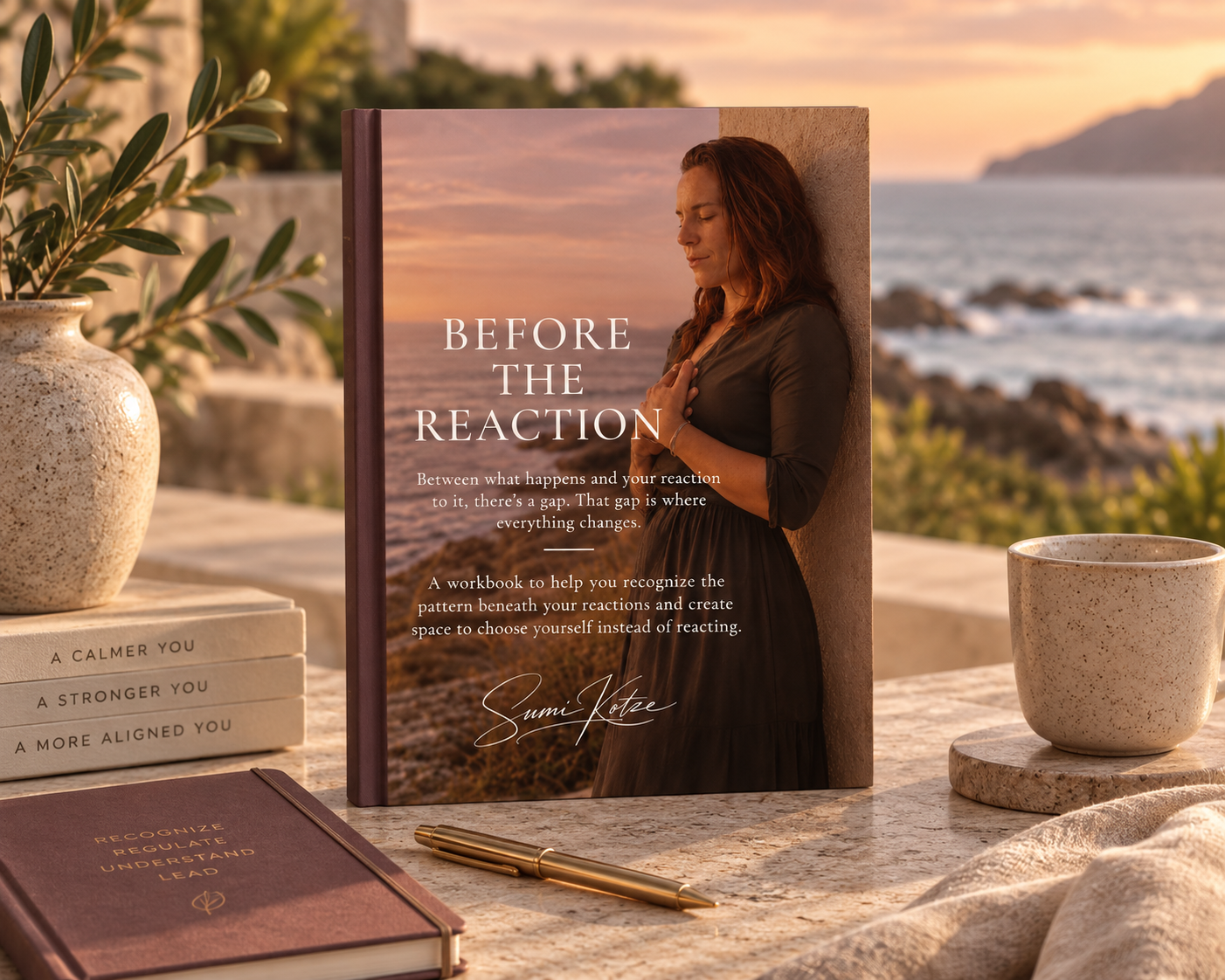
Catch the story your mind writes before you react, and find the space to choose what happens next.